NFX STR

Random Vibration Analysis for Airborne Equipment Structural Safety

  Airborne equipment experiences random vibrations that change at every measurement interval due to various conditions during flight operation — such as motors, noise, turbulence, and projectile launches — and structural safety and fatigue durability evaluations are required for these conditions. In this example, we will explore methods for verifying random vibration analysis of a condition monitoring system.

NFX STR

Why Transient Response Analysis Matters for Automated Transfer Equipment

Transfer equipment repeatedly cycles through stop, acceleration, travel, and deceleration conditions depending on its operating conditions. Just as a bus undergoes sudden braking, transfer equipment also generates vibration due to inertial forces in the structure caused by abrupt changes in velocity. Let us explore together how this can be evaluated numerically.

NFX STR

Structural Deflection Analysis for Heavy Equipment Support Structures

All structures on the ground are constantly exposed to seismic natural disasters, and seismic safety verification is an essential requirement. In this example, we will explore how to verify base station BBU communication server rack equipment using a analytical verification method called response spectrum analysis.

NFX STR

Vibration Fatigue Analysis for Base Station Equipment

Indoor communication equipment operates 24/7 and is continuously exposed to repetitive ambient vibrations depending on operating conditions. In this example, we will explore how to verify whether durability safety is secured against repetitive vibration loads on communication equipment through frequency response analysis.

NFX STR

Thermo-Structural Analysis of Semiconductor Equipment

Deposition coating equipment is constantly exposed to high-temperature environments during processing. To prevent issues related to airtight sealing and thermal deformation, the thermal distribustion of the structure under these confitions must be verifies. In this example, we will explore methods for analyzing and verifying temperature distribution and thermal deformation in the PECVD device cover under operating conditions. 

NFX STR

Typhoon Disaster Resistance Review of Outdoor Equipment Antenna Structures Suited to the Domestic Environment

 All structures installed outdoors are constantly exposed to the risk of typhoon disasters that can cause casualties, and structural safety verification is an essential requirement. In this example, we will explore how to perform analytical verification of antenna structures installed outdoors.  i

NFX STR

Review of seismic stability of communication server rack suitable for domestic environment

 All structures above ground are continuously exposed to earthquakes and other natural hazards, making seismic safety verification an essential requirement. In this example, we will learn how to verify the seismic integrity of a base station BBU communication server rack using the Response Spectrum Analysis method. 

NFX STR Earthquake Analysis

Design Validation of Network Equipment Mount Brackets Considering Seismic Events

Introduction:


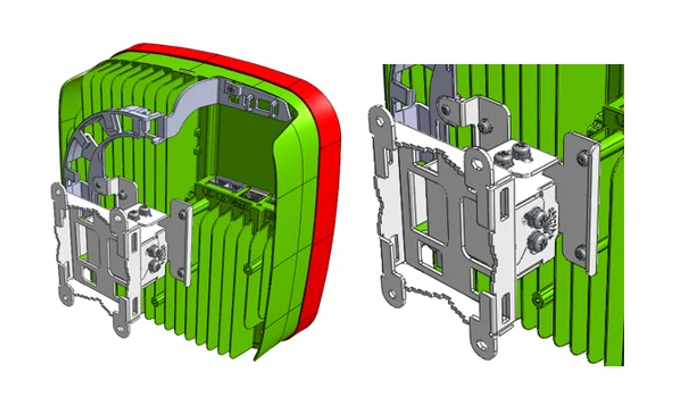
In the process of designing Network equipment for outdoor installations, it is essential to evaluate the seismic stability of brackets to prepare for potential earthquakes. Particularly crucial is determining whether the bolts applied to the brackets would withstand seismic forces.


NFX STR #rubber

Analyzing Automotive Component: Nonlinear Analysis of Door Belt

Introduction:


In the realm of automotive components, the door belt plays a crucial role in ensuring the flexibility of door glass operation, preventing glass damage, and obstructing the ingress of dust and foreign particles. In this blog post, we delve into the functionality and analysis of the door belt, particularly focusing on its nonlinear characteristics.


Analysis Methodology:


To conduct a comprehensive analysis, we utilized the 3D CAD geometry of the door belt and employed pre-processing capabilities of midas NFX to define material properties, load conditions, and boundary constraints. Paying special attention to the anticipated rubber deformation, we optimized mesh quality using manual mesh refinement features.


Nonlinear Static Analysis:


Emulating real-world scenarios, we performed nonlinear static analysis to scrutinize the compressive load and deformation patterns induced when compressing the model with glass, akin to experimental conditions. This nonlinear static analysis encompasses geometric, material, and contact nonlinearities, ensuring a holistic evaluation.


Material Modeling:


In defining the rubber material, we leveraged a hyperelastic model along with Mooney-Rivilin constants. Should material property constants be unknown, experimental data can be used to derive these values. The NFX platform facilitates this process through the "Evaluate Experiment data" feature.