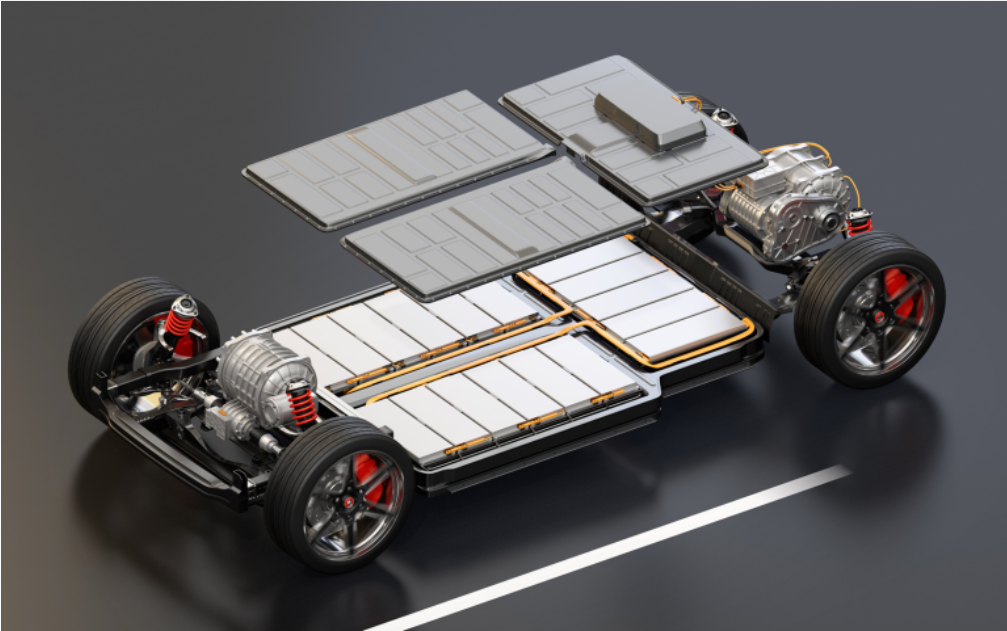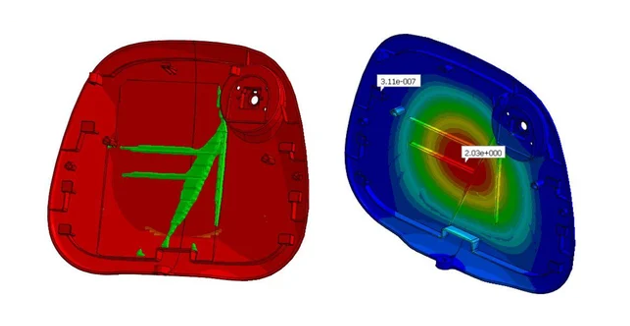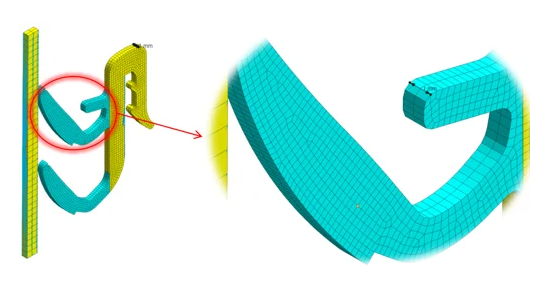
Transfer equipment repeatedly cycles through stop, acceleration, travel, and deceleration conditions depending on its operating conditions. Just as a bus undergoes sudden braking, transfer equipment also generates vibration due to inertial forces in the structure caused by abrupt changes in velocity. Let us explore together how this can be evaluated numerically.
1. Understanding Vibration Characteristics Under Operating Conditions of Automated Transfer Equipment
Today's topic is the "vibration characteristics" of transfer equipment.
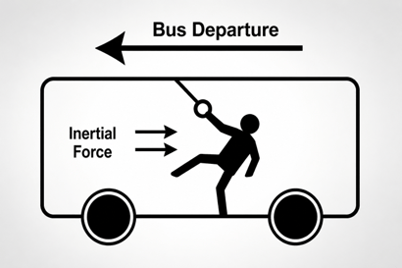
Example of internal forces due to velocity changes
Vibration in transfer equipment is generated by inertial forces.
The most familiar everyday example of this is when a bus suddenly accelerates from a stop or comes to an abrupt halt. You can easily experience your body lurching forward or backward due to a sudden change in speed.
Vibration caused by abrupt changes in velocity can damage products during the transfer process. "At what speed should the equipment operate??“ "Can heavy products also be transported safely??"
Let us look together at how to verify various conditions using quantified data.
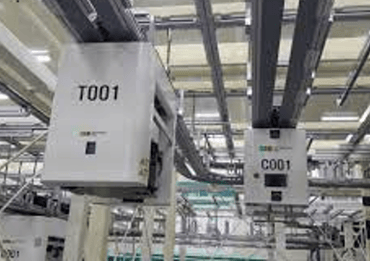
Example of transfer equipment
2. Why Is It Necessary to Review Inertial Forces Due to Velocity Changes?
The automated transfer equipment that is the subject of this topic refers to equipment that automatically transports parts or products to locations where repeated transfer is required in order to improve production efficiency. In semiconductor manufacturing processes, OHT (Overhead Hoist Transport) equipment — which transports wafer FOUPs (Front Opening Unified Pods) — is commonly used, and the transfer equipment is operated automatically according to the applied logic.
Considering the process of an OHT transfer system, it will repeatedly cycle through the following sequence: (stop – product loading – acceleration – constant-speed travel – deceleration – stop – product unloading). Since loaded products may be damaged during transfer, it is important to predict how the OHT transfer equipment and the loaded products (wafer FOUPs) behave during the transfer process and to identify potential issues.
3. How Can Vibration Caused By Inertial Forces Be Defined and Evaluated?
You can also understand this physical phenomenon through everyday experience. If you imagine a bus suddenly accelerating from a stop or making an unexpected emergency stop while in motion, those of us standing inside the bus would tend to fall forward or backward due to the inertial force from the motion. However, if the magnitude of acceleration/deceleration is reduced, or if there is something nearby to hold onto, we would be able to stand far more stably.
In transfer equipment as well, during phases where velocity changes abruptly under acceleration or deceleration, inertial forces initially cause a sudden deflection in one direction, which subsequently manifests as oscillatory vibration. Since this vibration can damage the loaded products or the transfer equipment itself, it is critically important to quantify both the magnitude of the vibration and the time required for it to settle, using numerical data.
Let us now explore together how analysis and verification can be performed to assess the vibration characteristics and structural stability of transfer equipment under various driving conditions. The example presented is a review of an OHT transfer system loaded with a wafer FOUP, examining the magnitude of vibration and settling time that occur in the structure under assumed driving conditions, and evaluating whether structural safety is achieved.
list view