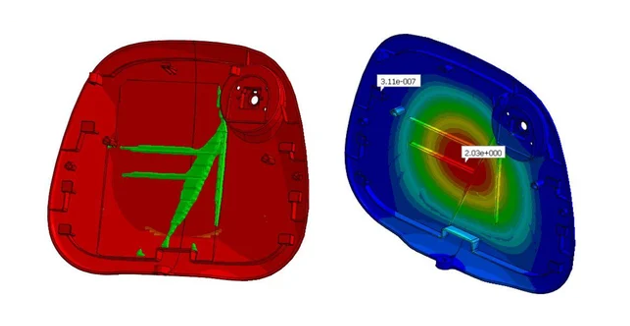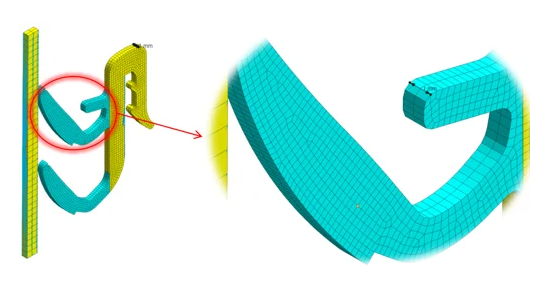
All structures installed outdoors are constantly exposed to the risk of typhoon disasters that can cause casualties, and structural safety verification is an essential requirement. In this example, we will explore how to perform analytical verification of antenna structures installed outdoors.
1. Typhoon Disaster Resistance Review of Outdoor Equipment (Antenna)
Today's topic is "typhoon disaster resistance" of structures.
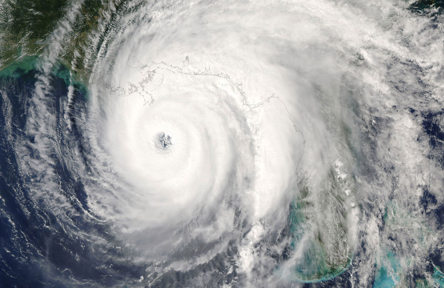
Typhoon example
Outdoor equipment installed on the exterior of buildings is directly exposed to wind. "Rusa" / "Maemi" / "Olga" / "Bolaven" … Because typhoons are unpredictable, it is necessary to verify whether the installed structure will be safe.
A variety of damage scenarios can occur, ranging from primary damage such as the overturning or destruction of structures to secondary damage such as loss of communications during a disaster situation.
As this is a matter related to casualties, safety verification is mandatory at the time of installation, and the associated risks must be recognized and confirmed without exception.
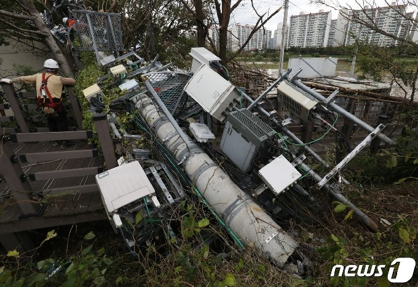
Typhoon accident case
2. Why Is It Necessary to Perform a Typhoon Disaster Safety Review for Structures?
All structures installed outdoors and in the open air, including the antenna equipment that is the subject of this discussion, are exposed to the natural disaster known as a "typhoon." In our daily lives, we frequently experience this natural hazard. Inland areas often experience only high-intensity winds, but coastal and island areas can suffer significant damage from extremely high-intensity winds strong enough to send people and structures airborne. If a typhoon does not dissipate, similar large-scale damage can also occur in inland areas.
In general, structures installed for buildings or special purposes are required to undergo mandatory disaster resistance verification for typhoons, because primary damage such as direct destruction as in an earthquake as well as secondary damage such as loss of communications and functional limitations can occur. Among all natural disasters, typhoon damage results in the largest scale of losses, reaching tens of billions of won, and occurs relatively frequently.
In addition to typhoon disasters, building wind effects occurring in densely built urban areas and sudden turbulence changes caused by surrounding structures can occur, making structural safety reviews essential to prevent structures from collapsing or overturning.
3. How Can Typhoon Disasters Be Numerically Defined and Evaluated?
Wind load is generally defined as the force applied per unit area, i.e., pressure. However, it is impossible to know whether the data collected or measured at a given time is truly representative of that region, or whether similar conditions will occur in the future. For this reason, structural safety reviews are performed using the maximum basic wind speed for each region, established on the basis of decades of meteorological agency data, to ensure a conservative assessment.
In general, architectural and civil engineering design standards specify basic wind speed conditions for typhoon disasters suited to the environmental conditions of each country. The final wind load applied to a structure is calculated by incorporating factors such as the structural form of the building, installation location, and turbulence variations mentioned above. In Korea, this is codified under KDS (Korea Design Standard), and on this basis, wind loads for communication facilities are determined in accordance with the "Technical Standards for Grounding Facilities, Premises Communication Facilities, Line Facilities, and Telecommunication Common Ducts" promulgated by the National Radio Research Agency.
Let us now explore together how analytical verification can be carried out for typhoon disaster resistance reviews. The example model is an antenna communication device installed on the exterior of a building. This document reviews whether the structure has seismic stability by simulating the domestic communication facility wind load requirements announced by the National Radio Research Agency in accordance with higher-level statutes.
list view