

Overview
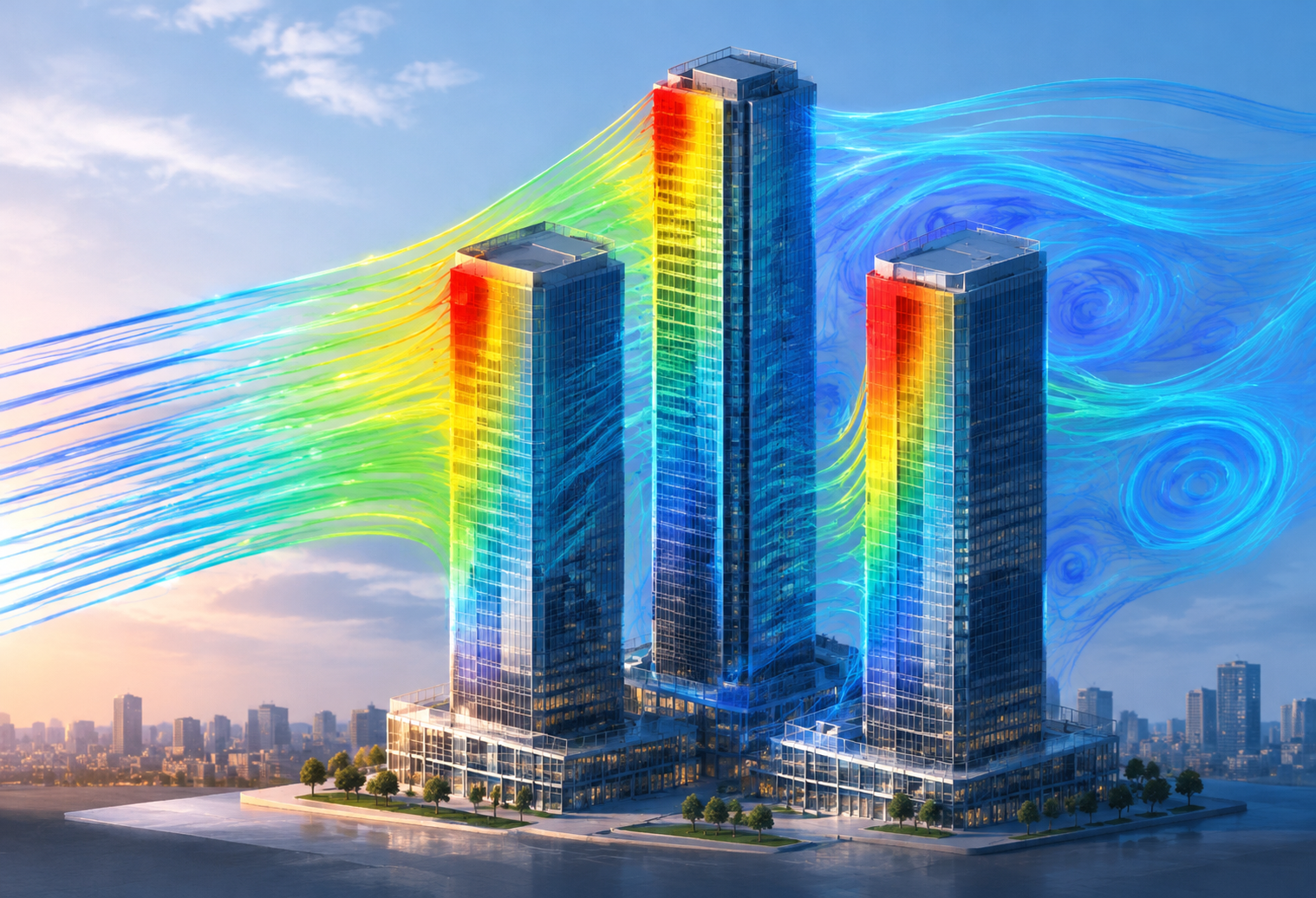
Airflow around structures generates complex pressure distributions that directly influence structural performance and safety. CFD analysis provides a powerful approach for predicting aerodynamic behavior, evaluating pressure coefficients, and supporting data-driven engineering decisions throughout the design process.
1. Understanding Pressure Coefficients Around Structures
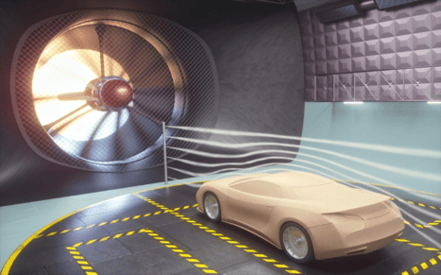
Although fluid flow is invisible in everyday life, it naturally changes direction and flows around obstacles such as buildings and structures. Common examples can be observed in wind tunnel tests of automobiles, buildings, and aircraft, where smoke visualization is used to reveal airflow patterns around the object.
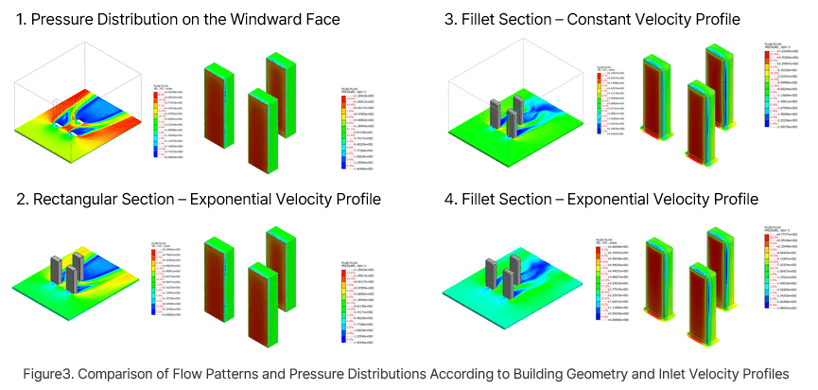
As fluid passes around a structure, boundary layers and flow separation develop near the surfaces, creating regions of positive and negative pressure depending on the location. Design standards often provide pressure coefficients derived from extensive experimental testing for various structural geometries. These phenomena can also be evaluated using CFD analysis.
2. Why consider External Flow Around Structures?
When a fluid such as air or water encounters an obstacle, it cannot pass through the solid object and is forced to flow around it. During this process, the fluid velocity decreases near the surface due to wall friction and boundary-layer effects. Flow separation may then occur, generating complex flow structures and recirculation regions.
These flow phenomena can significantly affect structural loading. Recirculation regions may create low-pressure zones and suction effects, while windward surfaces experience positive pressure and leeward surfaces may experience negative pressure.
Since dynamic pressure is commonly calculated as:

However, dynamic pressure alone does not fully represent the actual pressure distribution acting on a structure. For accurate structural design, additional factors such as shape coefficients and pressure coefficients obtained from experiments, design standards, or CFD simulations must be considered.
3. How Can Pressure Variations Around Structures Be Evaluated?
To evaluate pressure variations around structures, it is important to understand flow separation and recirculation regions generated near walls, corners, and sharp edges, and to track the resulting pressure distribution. In wind tunnel testing, pressure measurements are typically obtained using pressure taps installed at designated locations.
.....
Explore the Full Resource
Get practical insights, proven approaches, and real-world engineering examples