

Overview
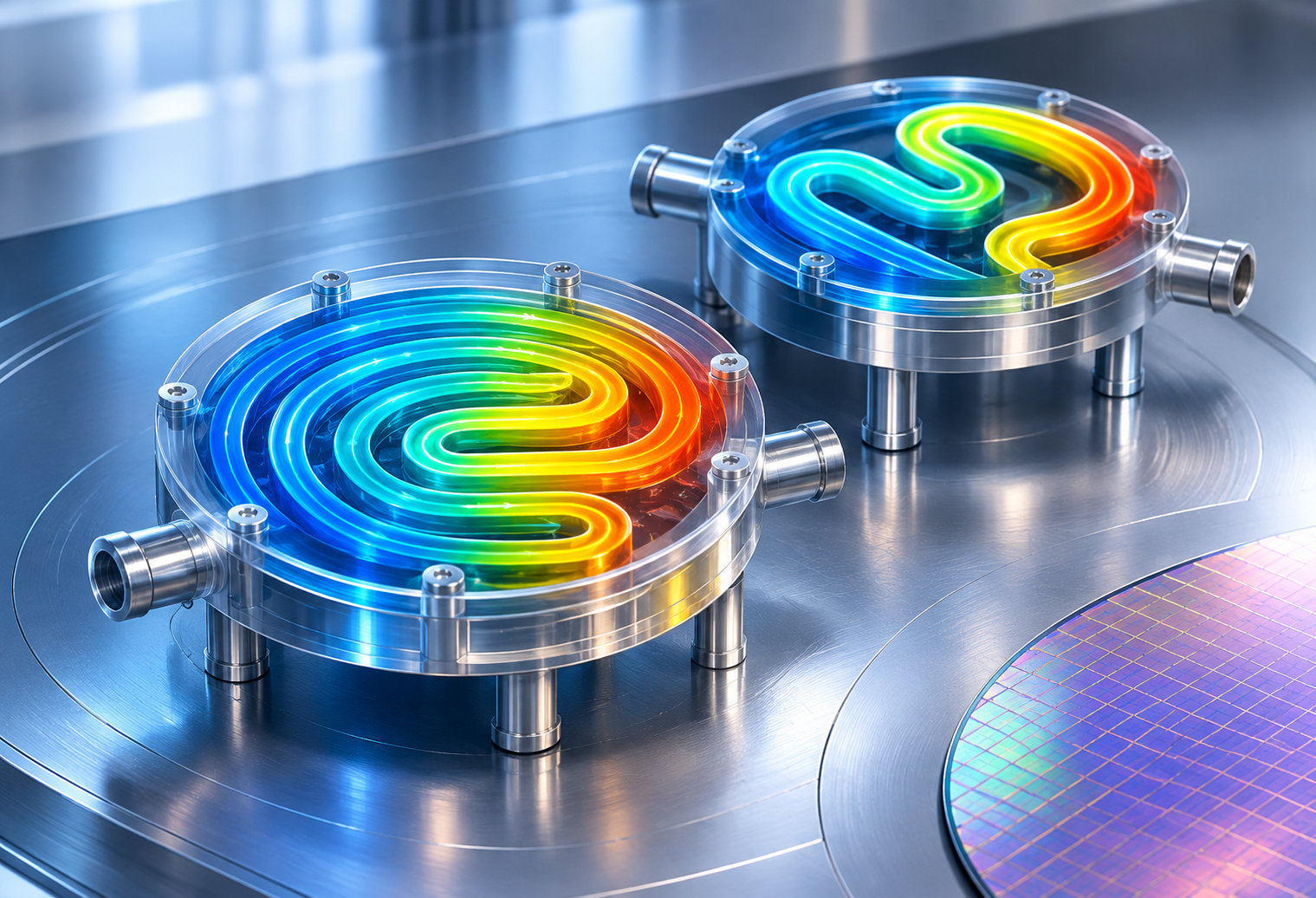
Cooling channel design directly influences temperature uniformity, cooling performance, and pressure loss. This study evaluates multiple channel configurations to identify an optimized cooling design for wafer heater applications.
1. Cooling Performance through Cooling Channels.
When considering thermal management design, the choice of coolant cannot be overlooked. Various media such as coolant, water, and air are commonly utilized. However, cooling performance and thermal management strategies vary depending on the selected medium, making it important to understand the appropriate design approach for each application.
For products such as wafer heater blocks operating in vacuum environments and at elevated temperatures, air cooling methods may be limited. In such cases, cooling channels carrying high-conductivity coolant are often integrated into the heater block to maximize cooling effectiveness.
2. Why Use Particle Analysis?
One of the first factors to consider in thermal management design is the type of cooling medium. In general, cooling methods can be categorized into air cooling using fans or HVAC systems, liquid cooling using piping networks, and immersion cooling utilizing coolant reservoirs. The appropriate cooling medium and cooling method should be selected according to the operating environment and design objectives.
Air cooling is commonly used in large spaces such as buildings or in confined environments where flow-path design is difficult, such as inside electronic equipment. In these cases, airflow can be controlled through HVAC systems using devices such as cooling fans and cross-flow fans.
Liquid cooling, on the other hand, provides significantly higher heat transfer capability—typically 20 to 30 times greater than air—resulting in superior cooling performance. However, because liquids are affected by gravity, dedicated flow-channel design or coolant reservoirs are required. Liquid cooling is primarily used in applications requiring vacuum environments, such as semiconductor equipment, or where localized cooling performance must be maximized, such as CPU cooling systems. Selecting the appropriate cooling medium based on design objectives is therefore essential.
3. What should be considered in Liquid Cooling Design?
In liquid cooling systems, heat exchange occurs through coolant flow, making flow-channel design a critical factor. In particular, increasing the contact area between the coolant and the heat source improves heat transfer efficiency. However, excessive heat transfer near the inlet region may raise the coolant temperature too rapidly, reducing heat transfer performance downstream. Since this can affect temperature uniformity, maintaining a balance between uniformity and heat transfer efficiency is important.
Optimized flow-channel design is therefore essential, and temperature distribution must be carefully evaluated according to channel geometry. Since these factors can produce conflicting results, achieving an appropriate trade-off between temperature uniformity and heat transfer performance is critical.
.....
Explore the Full Resource
Get practical insights, proven approaches, and real-world engineering examples