

Overview
1. Temperature Review of forced convection cooling performance of communication repeater fan
The topic we will cover today is the “fan cooling performance” of the structure.

In the 5G era, communication equipment, including communication repeaters, has become more compact and energy-efficient while delivering higher performance. As a result, heat generation has become a major design issue, and the demand for effective thermal management continues to increase.

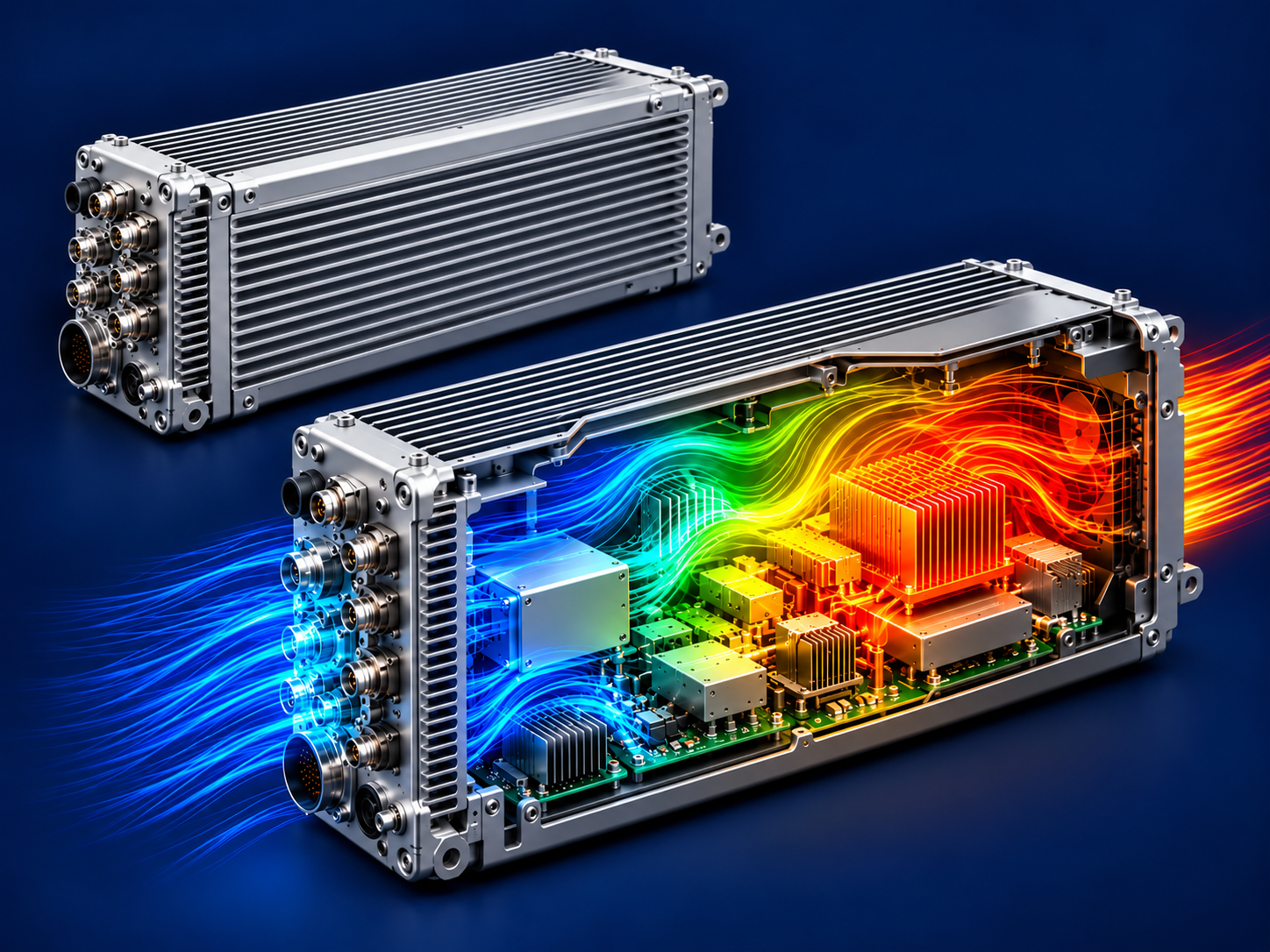
Forced convection cooling using fans is one of the most commonly applied cooling methods for this type of equipment. However, airflow and heat transfer behavior inside the equipment cannot be fully evaluated by visual inspection alone. Therefore, CAE-based thermal-fluid analysis is commonly used to assess whether the cooling design performs as intended.
2. Why is it necessary to review heat flow analysis for structures?
Quantitative analysis results are essential for an efficient design approach. By evaluating airflow distribution according to fan location and quantity, identifying stagnant regions where heat may accumulate, and verifying whether cooling performance is sufficient, engineers can optimize the thermal design before production.
Considering that hundreds or thousands of units may be manufactured after a single product is developed, optimizing the cooling design under various operating conditions is important not only for product safety and reliability but also for reducing production costs.
3. How can we define and design “cooling performance”?
According to the basic principles of heat transfer, heat is transferred from regions of higher temperature to regions of lower temperature until thermal equilibrium is reached. In thermal design, heat dissipation is achieved by transferring heat generated inside the equipment to the surrounding environment through conduction, convection, and, in some cases, radiation.
Fluids are commonly used in heat dissipation systems because they can transport thermal energy away from heat-generating components. Liquid cooling systems can provide high cooling performance in compact spaces due to the superior heat transfer capability of liquids. In contrast, air-cooled systems remove heat by increasing the heat transfer surface area, such as through heat dissipation fins, and by enhancing airflow using fans.
This example focuses on the analysis and verification of fan-driven forced convection cooling. Since the target model is a communication repeater with limited internal space, an air-cooled design was applied using heat dissipation fins and forced airflow generated by a fan, rather than a liquid cooling system.
.....
Explore the Full Resource
Get practical insights, proven approaches, and real-world engineering examples