

Overview
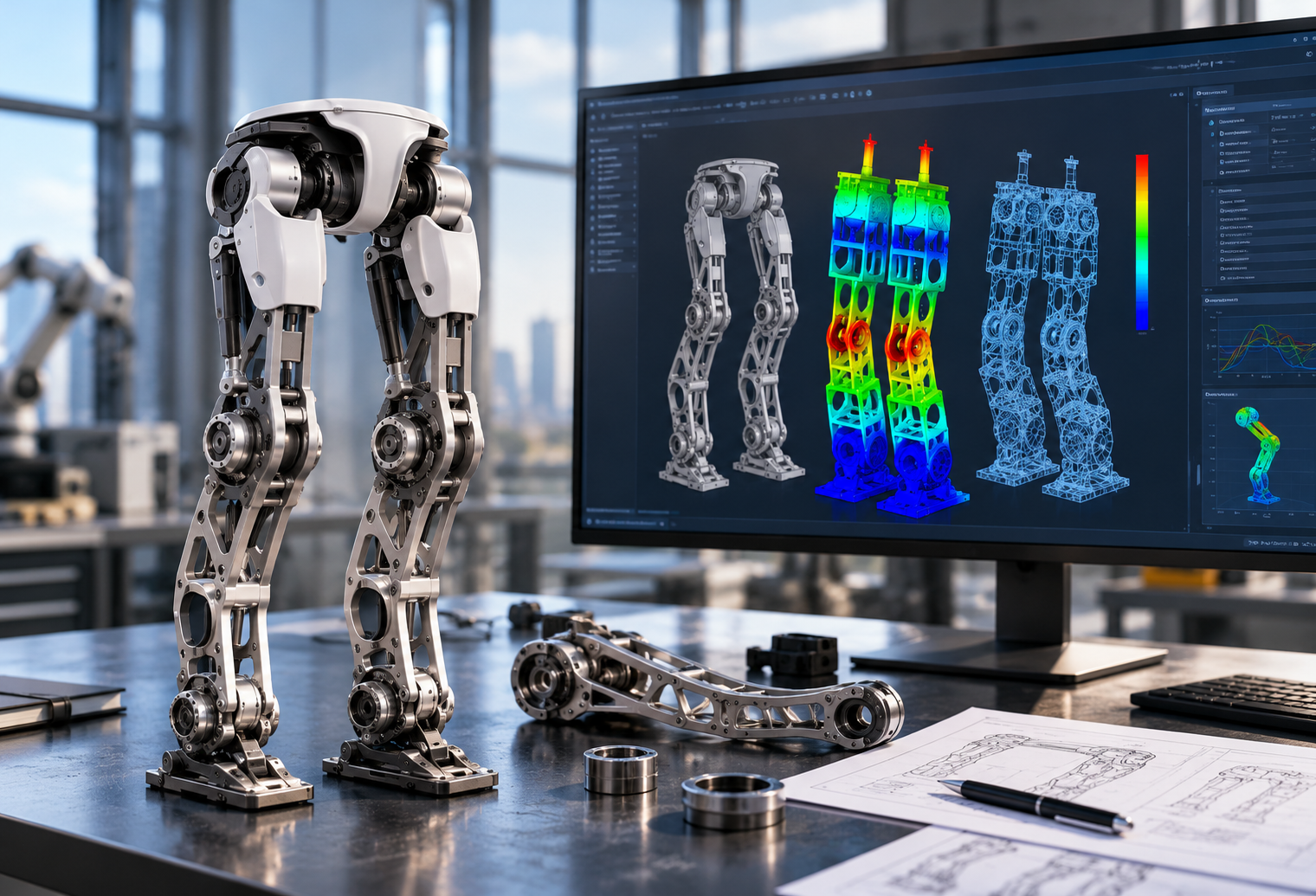
The leg frame of the 3rd-generation KEBO robot incorporates various drive systems, and its motion can be simulated through frame elements, interpolation elements, and contact conditions. The objective is to model the leg frame using CAE analysis, and to verify natural frequencies via modal analysis and stiffness via linear static analysis.
1. A Simple Stiffness Evaluation Method for the Robot Leg Frame
Today's topic is the "stiffness evaluation" of structures.
The presence of robots in our daily lives is becoming increasingly natural and widespread.
Incorporating AI and a wide range of technologies — from human-like motion to joint kinematics — robots represent a convergence of diverse engineering capabilities.
Since robots are composed of components with significantly higher mass compared to humans, substantial loads are generated during operation.
Just as bones provide structural integrity to the human body, the overall safety of a robot's frame is fundamental to its design, and ensuring structural safety remains a persistent concern.

2. What Is the Approach to Building a CAE Model for Complex Geometries?
As the application of robots continues to expand, their presence is being strongly felt across various industries and in everyday life. These robots are being designed through the complex integration of diverse technologies — from cutting-edge AI to intricate structures and drive systems. As a result, the design of robots has become a far more complex and challenging process than before. Nevertheless, continuous research and development efforts have been made to meet the specific requirements and needs of each industry.
Among these, key components such as the robot's leg frame can be designed flexibly according to their purpose and function. In this context, the stiffness evaluation of the frame is treated as a critically important task. By simplifying unnecessary elements such as complex drive systems and effectively streamlining interpolation and contact conditions, the review of motion accuracy and safety can be conducted more rapidly. Such an optimized design not only enhances the operational efficiency and service life of the robot, but also simplifies maintenance and management.
Building a CAE model for complex robot geometries requires not only a technical approach but also one aligned with the review objectives. Unnecessary drive systems and similar components can be simplified using interpolation and contact conditions, enabling rapid assessment of natural frequencies and safety under motion and loading conditions.
3. How Can an Analytical Approach Be Applied to the Robot Leg Frame?
The analytical approach to the robot's leg frame is carried out from multiple perspectives. First, necessary and unnecessary components are identified based on the analysis objectives, followed by element generation for the required parts and conditioning for the unnecessary parts. In the current model, 2D and 3D structural elements are applied to the frame, while interpolation elements are used for the drive system and contact conditions are employed to simulate the overall drive mechanism.
Structural analysis is used to evaluate fundamental structural characteristics of the frame, including strength, stiffness, and stability. This involves the use of techniques such as FEA to precisely analyze stress, deformation, and safety factors in the components. Dynamics analysis is performed to examine the dynamic behavior of the frame during motion. In this process, potential issues such as vibration, impact, and resonance that may arise during robot operation are identified in advance and countermeasures are explored.
.....
Explore the Full Resource
Get practical insights, proven approaches, and real-world engineering examples