


Overview
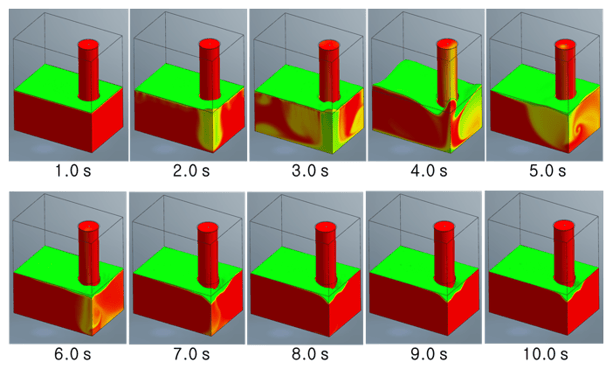
This analysis successfully reproduced the free-surface deformation and vortex formation characteristics observed in the benchmark experiment, confirming the applicability of CFD for evaluating pump intake hydraulic performance and vortex-related design issues.
1. Vortex Formation in Small-Scale Hydraulic Systems
Vortex phenomena are rotational flow patterns that occur within fluids and can be observed under a wide range of operating conditions. Although vortices may be generated by external disturbances such as waves or strong environmental forces, they are more commonly caused by changes in internal circulation patterns within the fluid domain.
This study focuses on vortex formation induced by the suction effect of a pump inlet. To verify the reliability of the simulation, the numerical results were compared against the experimental data reported by Matsui and additional benchmark test results. The comparison primarily evaluates vortex location and air-core development characteristics.

2. Why Is It Important to Investigate Vortices Near Pump Inlets?
Research on pump intake vortices is commonly performed using CFD simulations. The complexity of pump systems and various environmental conditions make it difficult to predict and control flow behavior, and these factors can significantly affect pump performance and operational efficiency.
Conducting full-scale physical tests for vortex phenomena in hydraulic facilities requires considerable time, cost, and resources. Large-scale water systems often demand extensive experimental equipment, observation facilities, and measurement efforts.
Therefore, CFD-based CAE analysis is widely used during the design stage to identify potential hydraulic issues before physical validation. Numerical simulation enables rapid evaluation of hydraulic structures and operating conditions in a virtual environment, reducing development costs while providing valuable insights prior to experimental verification.
3. Key Considerations for Pump Intake Flow Analysis
In Snap-fit design using geometry, the most important aspect is verifying the degree of plastic deformation and structural safety as a function of the interference fit level. Because the principle relies on the difference in geometric dimensions to resist loosening after engagement, forced plastic deformation occurs repeatedly, and its magnitude becomes a key variable that determines whether failure occurs as well as the engagement/separation force.
.....
Explore the Full Resource
Get practical insights, proven approaches, and real-world engineering examples