

Overview
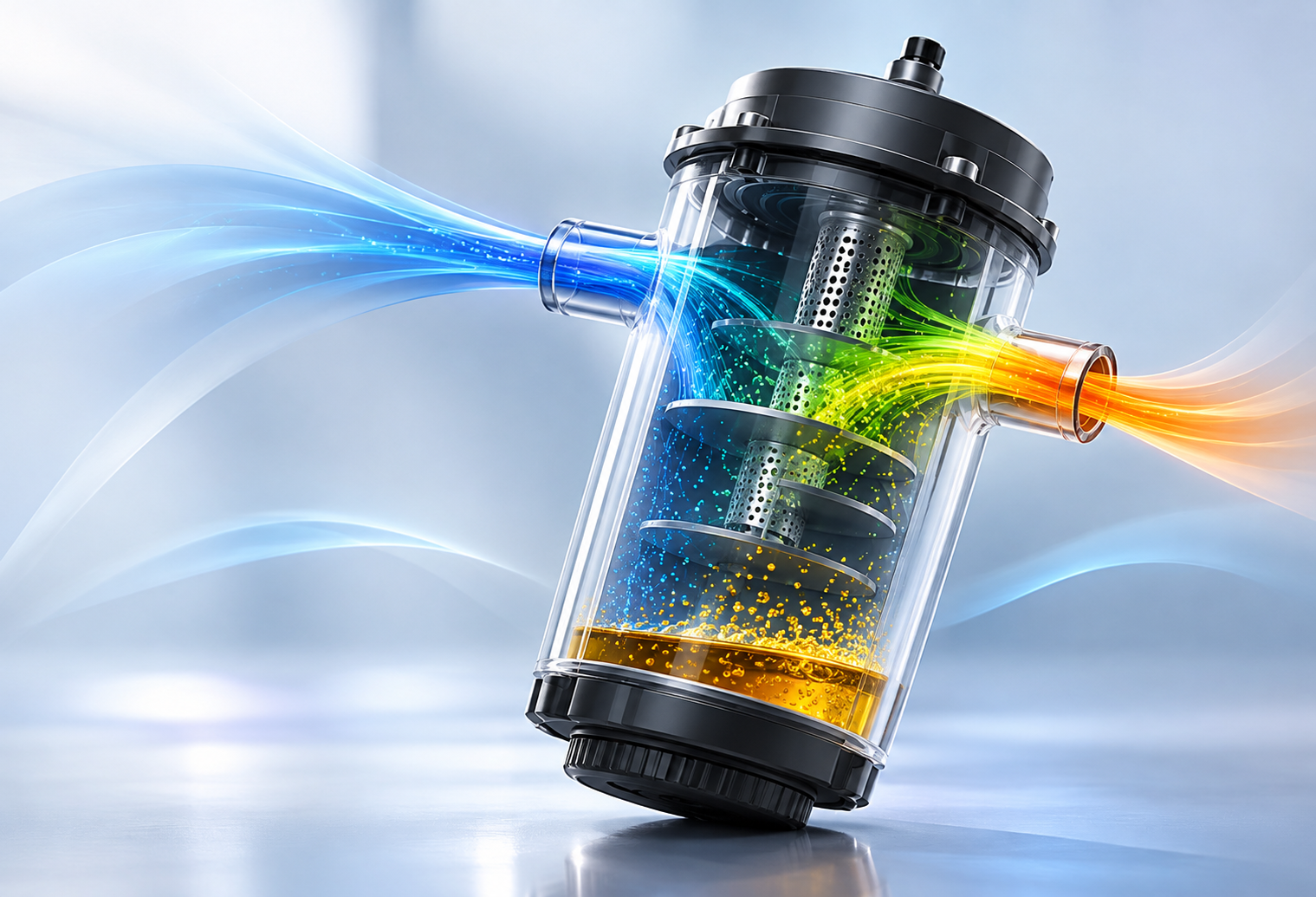
Oil catch cans are widely used in automotive engines to separate oil droplets and other contaminants from blow-by gases before they re-enter the intake system. Their collection performance depends on how effectively suspended particles separate from the primary gas flow and deposit on internal surfaces such as baffles, filters, and walls. Since particle motion is influenced by both fluid flow and particle inertia, particle size plays an important role in determining overall capture efficiency.
1. Evaluating Capture Efficiency Through Particle Tracking Analysis.
An oil catch can is designed to remove contaminants contained in blow-by gas generated from vehicle engines. Its primary function is to separate and collect oil droplets and other impurities before they re-enter the intake system. The collection mechanism relies on capturing relatively heavy particles that deviate from the primary gas stream and deposit on internal baffles, filter media, or wall surfaces.
Particle motion is strongly influenced by the surrounding fluid flow. However, depending on particle size and inertia, particles may separate from streamlines due to drag and inertial effects. As particle size increases, capture behavior changes significantly, directly affecting overall collection efficiency.
2. Why Use Particle Analysis?
Particle analysis is a numerical technique used to track and predict the motion of discrete particles within a fluid flow field. Applications include dust, oil mist, vapor droplets, wear debris, and other suspended particulates.
By simulating particle trajectories under realistic flow conditions, engineers can evaluate particle transport, deposition, recirculation, penetration, and removal mechanisms.
In industrial applications, particle analysis is widely used for:
- Dust control systems
- Cleanroom contamination assessment
- Semiconductor process equipment
- Oil separator and filtration systems
- Brake wear particle evaluation
- Industrial ventilation systems
The methodology enables engineers to understand how particle size and operating conditions affect equipment performance and contamination control.
3. What Should Be Considered in Particle Analysis?
A converged fluid flow solution must first be obtained before particle tracking analysis can be performed. Depending on the interaction level between particles and the fluid phase, either a One-Way Coupling or Two-Way Coupling approach may be selected. Since micron-sized particles typically have negligible influence on the carrier flow, One-Way Coupling is generally adopted.
Small particles tend to follow fluid streamlines closely, while larger particles exhibit stronger inertial effects and are more likely to separate from the flow. Additional boundary conditions such as:
- Particle Capture
- Particle Reflection
- Particle Escape
can be defined to accurately represent real-world particle behavior.
These capabilities allow evaluation of:
- Airborne dust transport
- Oil mist collection
- Filtration performance
- Environmental control systems
- Industrial process equipment
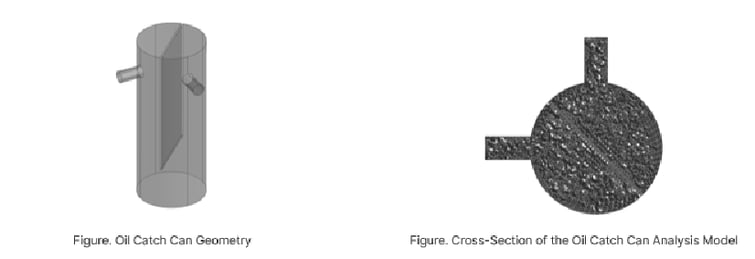
The objective of this study is to evaluate how particle size affects capture efficiency inside an oil catch can and to understand the relationship between particle inertia and wall capture performance.
.....
Explore the Full Resource
Get practical insights, proven approaches, and real-world engineering examples