

Overview
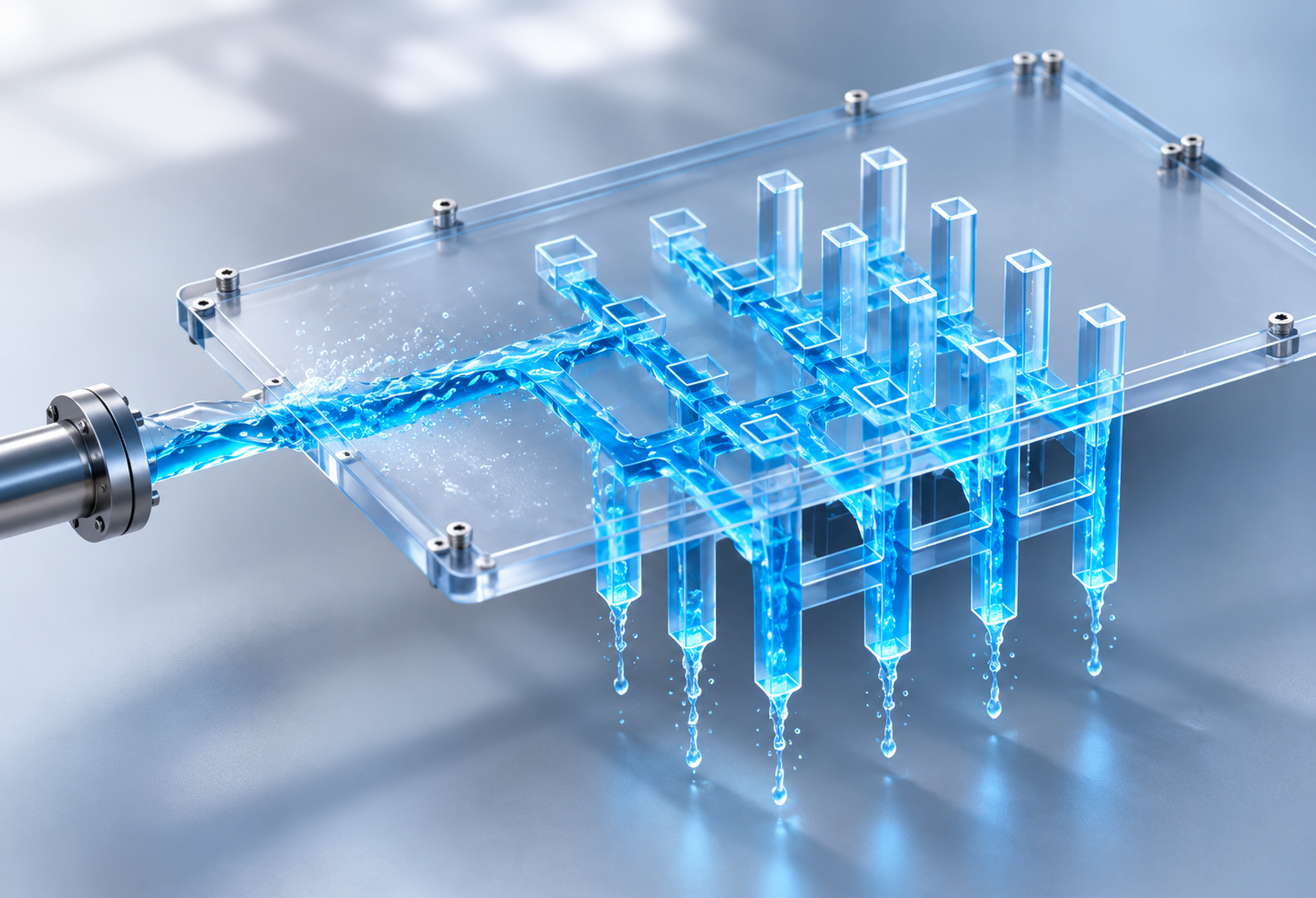
Liquid injection processes involve complex interactions between liquid and gas phases, where interface motion, air displacement, and transient flow behavior directly influence filling performance. Using advanced multiphase CFD technology, this study visualizes the complete filling process, predicts volume fraction evolution, and provides engineering insight into the design and optimization of fluid-filled structures.
1. Multi-Phase Fluid Flow Occurring Inside Enclosed Structures
In everyday life, we encounter many situations involving multiple fluids. Examples include mixing water and ink, as well as flows where air and water coexist without completely mixing. As shown in the figure, air and water can maintain a distinct interface while flowing. In some cases, the flow pattern itself can be visually observed through light refraction at the interface.
Many structures, such as blood glucose test strips or washbasins, initially contain air occupying empty spaces that are invisible to the naked eye. When liquids such as water or blood are injected into these structures, they displace the existing air, creating a filling process that can be readily observed.

2. What Are Mixture Flow and Multi-Phase Flow?
The common characteristic of both phenomena is that multiple fluids coexist within the same domain. Fluids generally include substances such as water, oil, and air. The key distinction lies in whether a clear interface between the fluids is maintained.
Multiphase flow refers to situations where fluids remain separated by an interface, even when they come into contact. Examples include water and oil, liquid-gas interfaces, LNG tank sloshing, liquid hydrogen storage tanks, and free-surface flow analysis.
Mixture flow, on the other hand, refers to flows where fluids occupy the same phase and do not maintain a distinct interface. Examples include water-ink mixing, chemical mixing tanks, and the transport and dispersion of gases such as carbon dioxide, nitrogen oxides, and smoke generated during tunnel fires.
3. What Should Be Considered in Liquid Injection Analysis Using Multi-Phase Fluid Flow?
Multi-Phase fluid flow analysis requires two fluids separated by an interface. In liquid injection problems, water and air are commonly assumed. Depending on the application, other combinations such as blood and air may also be considered. In most engineering applications, two fluids with a significant density difference are modeled, typically as a liquid and a gas.
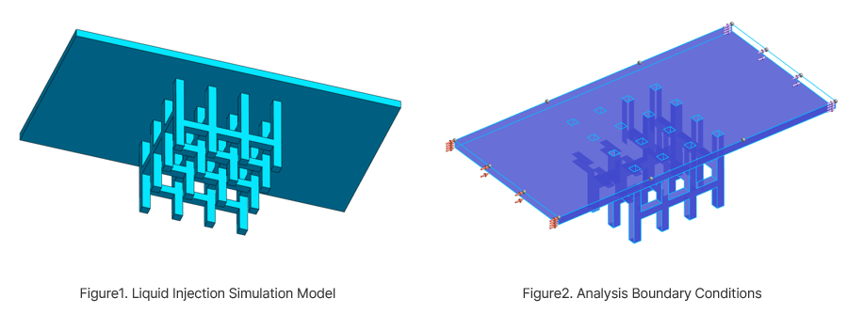
The analyst must define the fluid initially present in the domain, the location of fluid injection, and boundary conditions such as hydrostatic pressure due to elevation. To accurately represent real phenomena, these physical conditions should be modeled appropriately.
.....
Explore the Full Resource
Get practical insights, proven approaches, and real-world engineering examples