

Overview
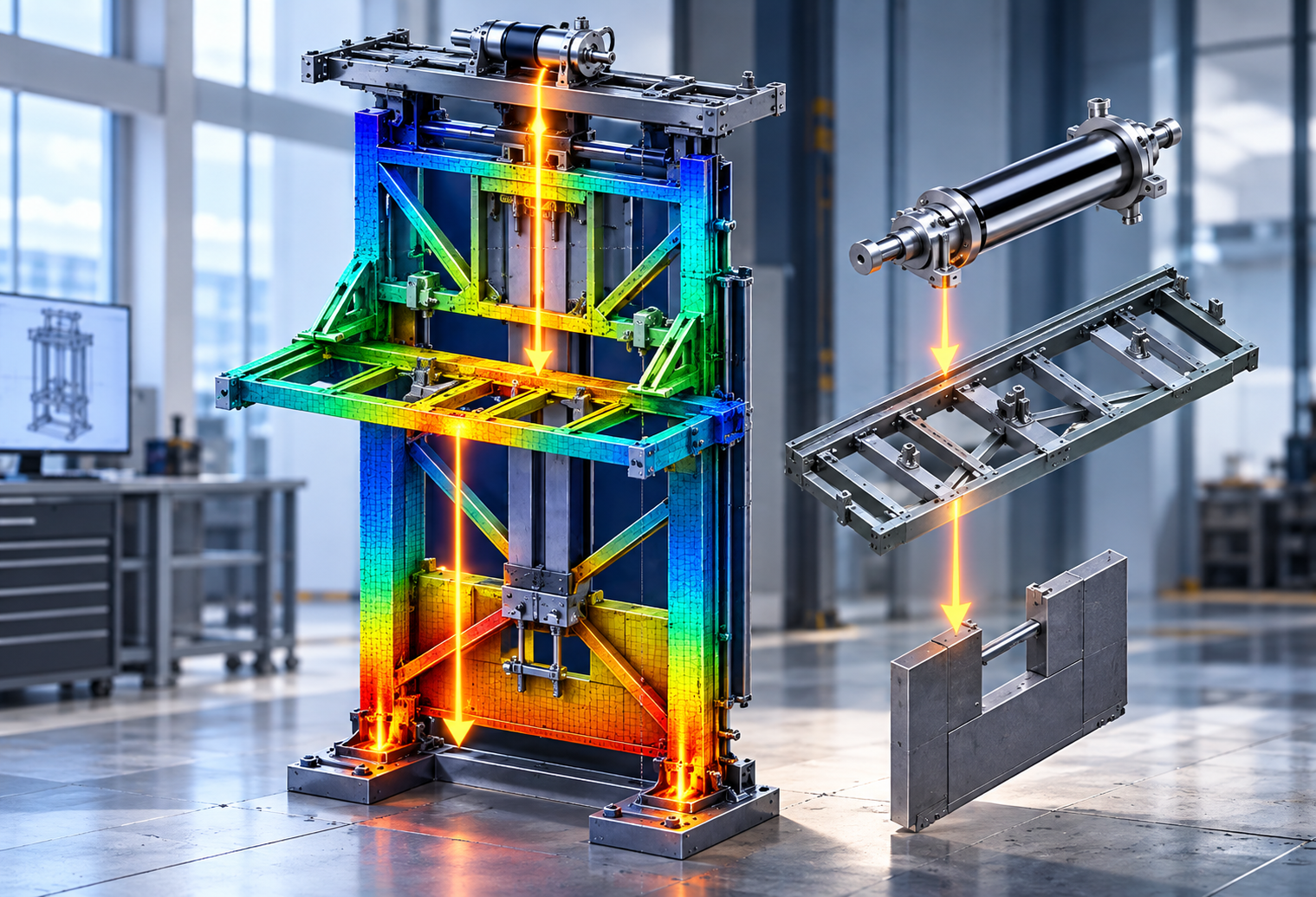
1. What is the method for evaluating structural stability based on force transfer in Lifter equipment?
Today's topic is about "rational simplification" in structural analysis.
The structural stability review of a "lifter" is performed with various component-level or partial simplifications. A lifter generally refers to equipment used to lift or move heavy objects, and is commonly used in industrial, construction, and manufacturing environments.
When a Lifter is in operation, force transfer occurs in the process of moving power or energy from a starting point to another point depending on the weight of the object being handled. Force transfer involves understanding how forces (torque or moments) are transmitted within a machine, and ensuring the stability and efficiency of the equipment throughout this transfer process is critically important.
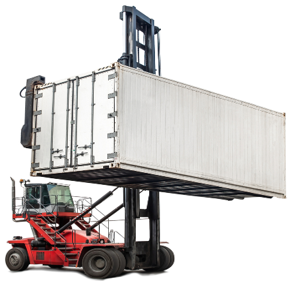
Container Lifting Equipment
The structural stability review of a "lifter" is performed with various component-level or partial simplifications. A lifter generally refers to equipment used to lift or move heavy objects, and is commonly used in industrial, construction, and manufacturing environments.
When a Lifter is in operation, force transfer occurs in the process of moving power or energy from a starting point to another point depending on the weight of the object being handled. Force transfer involves understanding how forces (torque or moments) are transmitted within a machine, and ensuring the stability and efficiency of the equipment throughout this transfer process is critically important.
2. Understanding and classification of the force transfer mechanism in Lifter equipment analysis?
Force transfer can be accomplished through mechanical, hydraulic, or electrical components. Force transfer mechanisms are broadly classified into three types: mechanical transmission, hydraulic systems, and electrical systems. Among these, the mechanical transmission method transfers force through mechanical components such as chains, gears, and belts. For example, rotational force generated by a motor is transmitted through a gearbox to a lifting arm or chain to lift an object. Hydraulic systems utilize the force generated by compressing oil or other hydraulic fluid. A hydraulic pump generates power, which is then transmitted to a hydraulic cylinder to actuate the lifter.
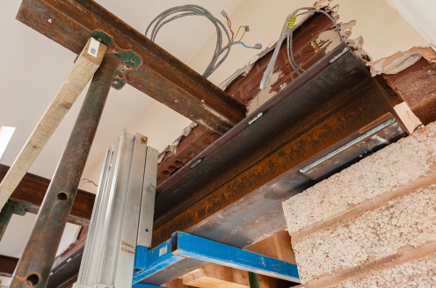
Steel Beam Reinforcement Structure
This method has the advantage of enabling precise control of large loads. Electrical systems use electric motors to generate force, which is then transmitted via mechanical components or hydraulic systems. Electrical force transmission is easy to control and offers high energy efficiency, making it widely used in various lifting equipment. In this topic, we aim to introduce an analysis method for ensuring structural stability through rational simplification of component units in Lifter equipment when the force transfer mechanism is implemented via mechanical transmission.
.....
Explore the Full Resource
Get practical insights, proven approaches, and real-world engineering examples