

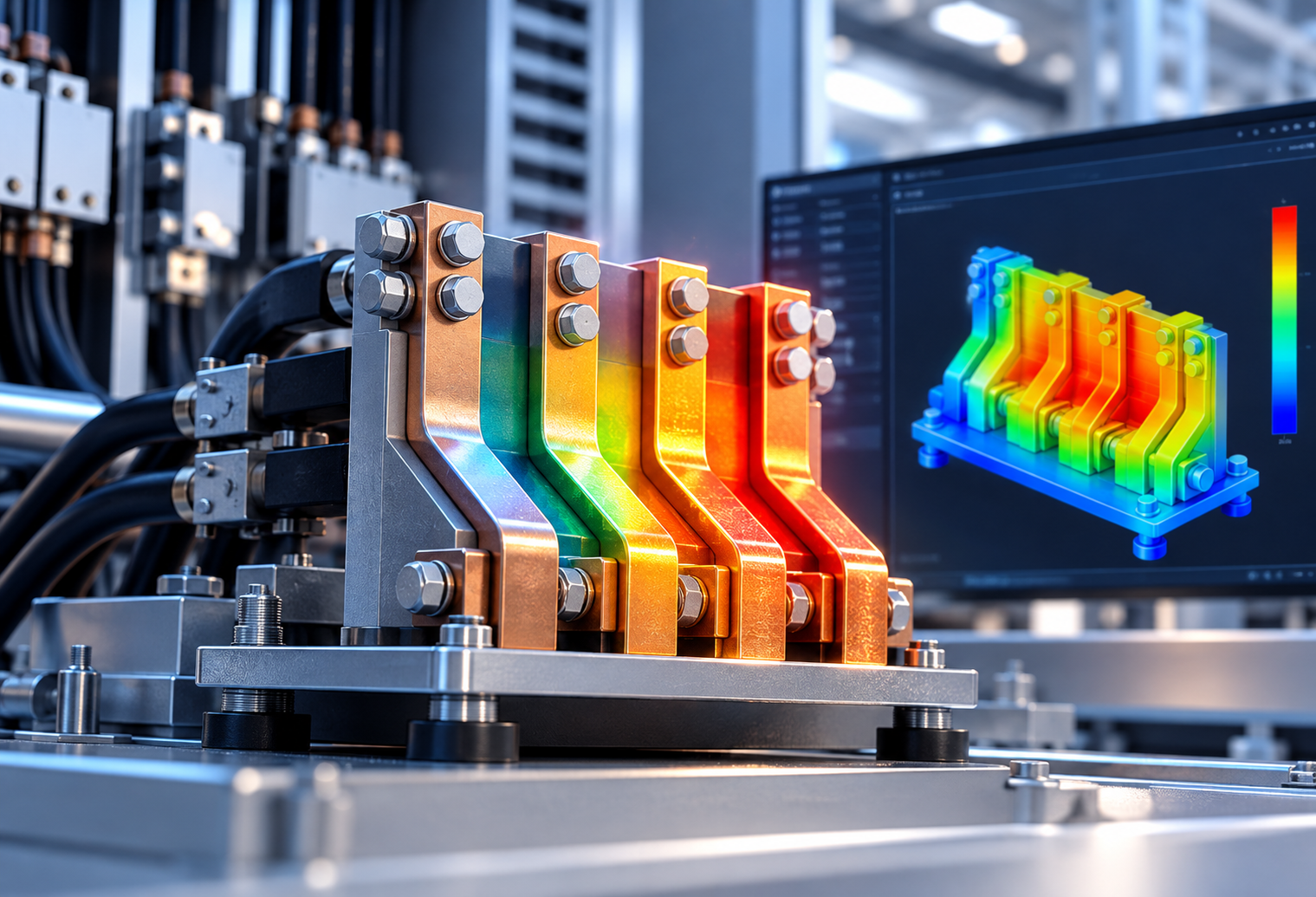
Overview
Electronic equipment contains various metallic components made of conductors. Depending on the voltage difference and the geometry-dependent resistance, current density is generated in the form of heat dissipation. Joule heating can occur in many components and requires detailed temperature analysis.
1. Joule heating analyzed through thermal analysis.
Understanding the difference between Heat Generation and Joule Heating in CFD simulation.
Various metallic components made of conductive materials are used inside electronic equipment. When an electric current flows through these conductive components, electrical resistance converts part of the electrical energy into thermal energy.
This phenomenon is known as Joule heating, and detailed temperature analysis considering this effect is required in many electronic applications.High-temperature conditions caused by Joule heating may lead to various problems in electronic components, ranging from reduced service life to fire hazards. Therefore, forced convection cooling using air is often considered in realistic temperature analysis and additional thermal design.
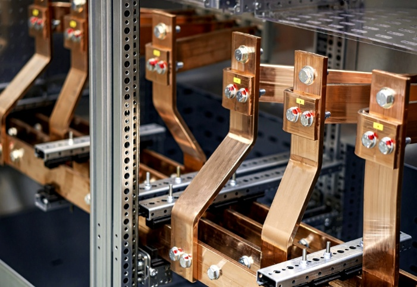
Materials in the Electrical Equipment
2. Why do we use Joule Heating Analysis?
In thermal analysis, heat generation is commonly defined as a volumetric heat source representing the amount of thermal energy generated within a body. However, this approach typically assumes uniform heat generation and does not directly account for current flow paths, local resistance, or geometric effects. As a result, it may not accurately represent heat generation in conductive components.
To analyze heat generated in circuit traces and conductive parts used in semiconductor and electronic equipment, electric field or electrical conduction analysis should be performed. This type of analysis can calculate resistive heat generation caused by electrical resistance. Since electrical properties can also vary with temperature, coupling electrical analysis with thermal analysis enables more accurate prediction of temperature distribution.
By reproducing actual operating conditions in a virtual environment, Joule heating analysis allows more accurate evaluation and prediction of thermal behavior. When coupled with structural and fluid flow analysis, it can be used to assess temperature changes and thermal effects within products under various operating conditions.
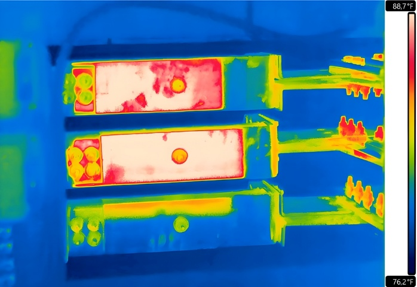
Thermal analysis
3. What should be considered in Joule Heating Analysis?
For Joule heating analysis, differences in voltage and geometry must be considered. Current flow is generated by voltage differences, and current concentration effects may occur depending on geometric discontinuities. Joule heating is often referred to as resistive heating. Using 3D CAD data, electrical conductivity, and voltage difference information, current density can be calculated and represented as heat generation.
After modeling Joule heating, consideration must be given to the coupled analysis domain. Typical considerations include:
- Whether cooling effects should be included
- Whether forced convection uses air cooling or water cooling
- Whether a cooling fan P-Q curve exists
- How thermal design can be improved if temperatures become excessive
These are common viewpoints from a temperature analysis perspective.
.....
Explore the Full Resource
Get practical insights, proven approaches, and real-world engineering examples