

Overview
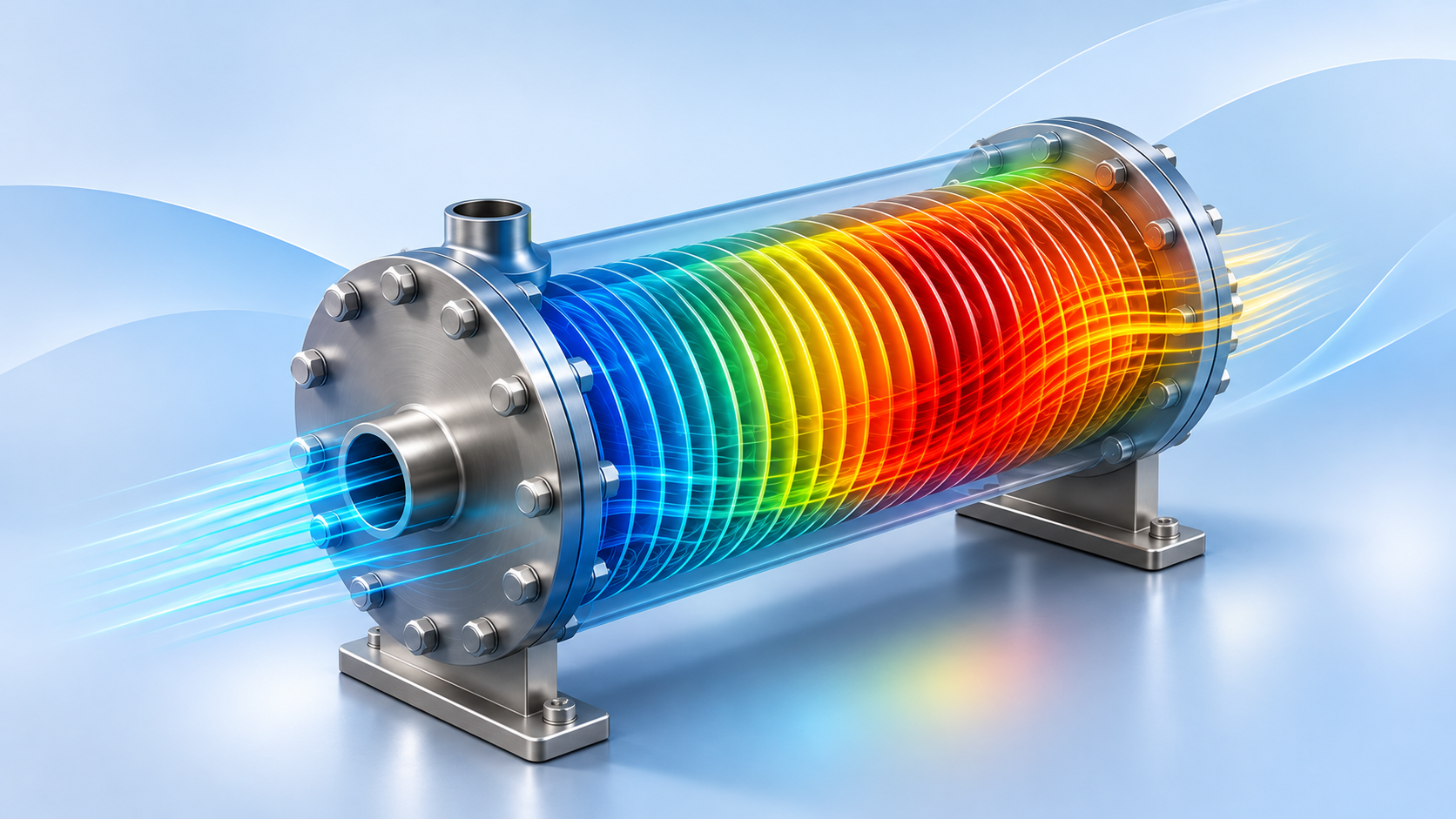
Evaluate the effect of heat exchanger fin geometry on internal flow behavior, including velocity distribution, pressure loss, flow uniformity, and heat transfer performance, using CAE-based fluid analysis.
1. How do fin shapes affect flow?
The topic we will cover today is about the “heat exchanger” of the structure.
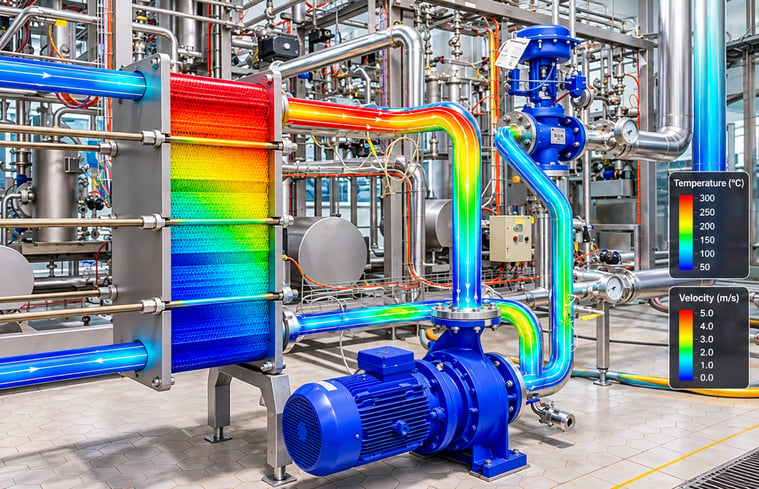
Heat exchangers are used to transfer thermal energy between fluids or between a fluid and a solid structure at different temperatures. Depending on the operating conditions and system configuration, heat exchangers may handle fluids at temperatures ranging from several tens to several hundreds of degrees Celsius or higher.
When designing a heat exchanger, various factors must be considered, including the temperature variation of each fluid, heat transfer efficiency, pressure loss, and the thermal deformation and thermal stress of the structure used as the heat transfer medium.
Because fluids generally have lower thermal conductivity than solids, a large heat transfer area is required to achieve efficient heat exchange. For this reason, plate or fin structures are commonly used to increase the contact area between the fluid and the heat transfer surface. Design variables such as fin pitch, fin number, and flow passage geometry are often adjusted to identify an effective heat exchanger configuration.
2. Why is fluid analysis necessary in heat exchanger design?
The heat exchanger structure considered in this example is designed to transfer heat between media with different temperatures. In many applications, high-temperature waste heat generated from electronic equipment, industrial systems, or power plants is recovered and used to heat another fluid. Conversely, heat exchangers may also be used to cool fluids when their temperature is too high.
Accurately evaluating heat exchanger performance can be difficult through field measurements alone because of high-temperature operating conditions, complex convection effects, and limited accessibility inside the flow passages. Local measurements or experience-based estimates may not provide sufficient quantitative information on how geometric changes affect heat exchange performance.
CFD analysis is widely used to evaluate various design parameters efficiently, such as fin spacing, heat transfer area, and flow passage configuration. The analysis can be extended beyond fluid flow evaluation to include temperature changes in both fluid and solid regions. In addition, CFD results can be coupled with structural analysis to assess thermal expansion, deformation, and thermal stress.
3. Effect of Shape on Heat Exchanger Performance
Heat transfer in a heat exchanger occurs through a combination of conduction and convection. Heat is conducted through solid components such as tubes, plates, or fins, while convection occurs between the solid surfaces and the working fluid. Therefore, both the solid geometry and the fluid flow characteristics must be considered when evaluating heat exchanger performance.
.....
Explore the Full Resource
Get practical insights, proven approaches, and real-world engineering examples