


Overview
1. Forced-Air Cooling Impact on EV Battery Pack Temperature
The topic we will cover today is “internal forced air cooling” of structures.
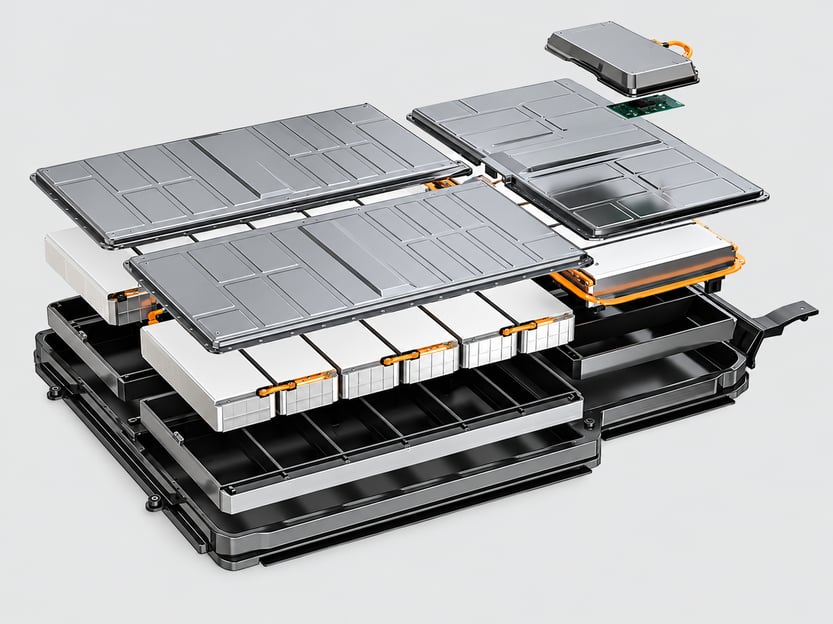
Electric Vehicle Battery Cells
Recently, battery packs have become a key factor directly affecting the performance of electric vehicles, making efficiency improvement and miniaturization important design requirements. However, safety concerns such as performance degradation at high temperatures and reduced battery life remain major challenges for designers.
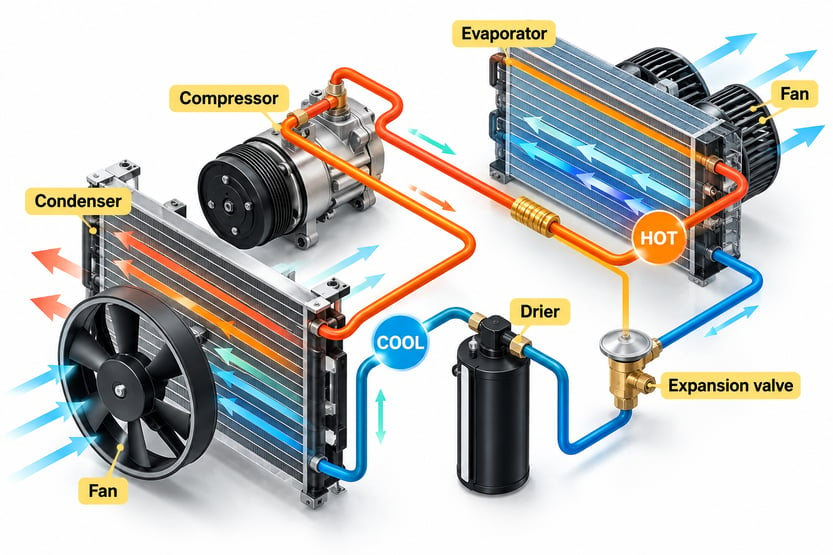
Automotive cooling system
In automotive applications, forced-air cooling is often used because airflow can be introduced and discharged through vehicle motion and duct structures during operation. Therefore, it is important to evaluate the internal airflow distribution and cooling performance of the designed product using CFD-based flow analysis.
2. Why is it necessary to review internal airflow analysis for structures?
One of the main advantages of internal flow analysis is that airflow paths and temperature distributions inside the structure can be visualized and evaluated intuitively. Although experimental verification is commonly performed during the design stage, internal airflow behavior and component temperatures are difficult to observe directly and are often assessed only through limited sensor or flow meter measurements.
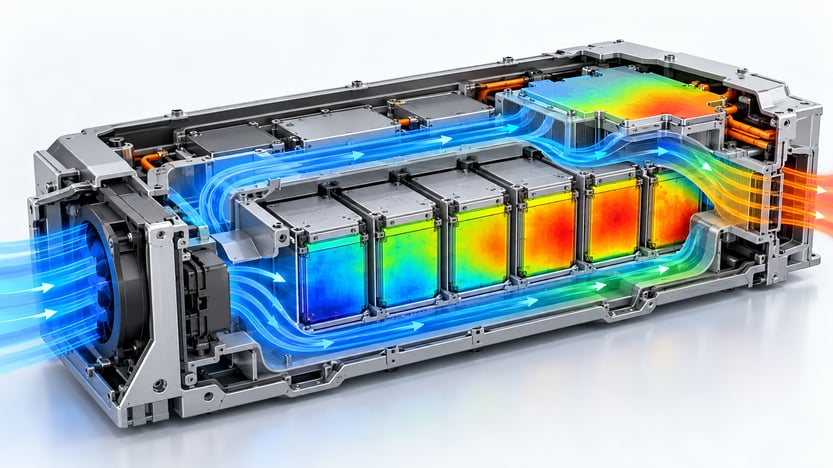
Thermal analysis
Internal airflow visualization is particularly useful for evaluating how duct geometry affects flow distribution and the resulting cooling performance. In forced-air cooling, heat is removed from component surfaces by moving air, so uniform flow distribution is critical. If multiple heat-generating components such as battery cells are present, non-uniform airflow can lead to uneven temperature distribution, which may cause performance degradation, reduced service life, thermal runaway, or fire risk
3. How can we define and design “forced air cooling”?
As mentioned earlier, in forced-air cooling, airflow velocity and heat transfer surface area are key factors affecting cooling performance. Higher airflow velocity and a larger contact area between the air and heat-generating surfaces can enhance convective heat transfer and improve heat dissipation.
From an analysis perspective, flow path geometry, fluid properties, and flow boundary conditions must be properly considered. CFD analysis enables detailed evaluation of the temperature distribution of the structure, as well as the velocity distribution within the flow path. It also allows engineers to assess how changes in duct geometry affect airflow behavior and thermal performance.
.....
Explore the Full Resource
Get practical insights, proven approaches, and real-world engineering examples