


Overview
Effective flow control is essential for achieving reliable thermal performance in modern engineering products. By analyzing the influence of flow resistance components on airflow behavior and heat transfer, CFD provides valuable insights for designing more efficient and thermally optimized systems.
1. Flow Resistance in Small Electronic Devices
Although fluid flow is invisible to the naked eye, it naturally moves from regions of higher pressure to regions of lower pressure. Inside and outside engineered products, fluid encounters various obstacles and geometric constraints, causing pressure variations and flow redirection.
Consider airflow passing through a perforated plate with numerous small holes. Compared to an open space, the flow experiences additional resistance, resulting in pressure loss and flow redistribution. Engineers intentionally utilize these effects to improve flow uniformity, control airflow paths, and enhance thermal management performance.

2. Why Consider Flow Resistance in Product Design?
Flow resistance is widely used as a design parameter in engineering applications. Fluid motion is primarily driven by pressure differences, and whenever fluid encounters obstacles, pressure losses occur. In systems such as filtration units, cooling modules, and ventilation devices, simply allowing fluid to pass through is not sufficient.
It is equally important to ensure that the supplied fluid is distributed uniformly and does not become concentrated in a specific region. To achieve this, designers often introduce resistance elements such as perforated plates, screens, guide vanes, and porous structures. These components help redistribute the flow, reduce local concentration effects, and improve overall system performance.
In electronic products, perforated structures are frequently used to improve airflow uniformity and increase interaction between the cooling medium and heat-generating components. Since even small changes in internal flow paths can significantly affect cooling efficiency, careful analysis and optimization are essential during the design process.
3. Key Considerations for CFD Analysis with Flow Resistance Components
Flow resistance can generally be categorized into two major types :
Inertial Resistance
Inertial resistance is commonly associated with structures such as perforated plates, screens, louvers, and grilles. It primarily affects the momentum of the fluid as it passes through geometric obstructions.
Viscous Resistance
Viscous resistance is commonly observed in porous materials such as filters, sponges, and fibrous media. It is often modeled using Darcy’s Law and is associated with frictional losses within porous structures.
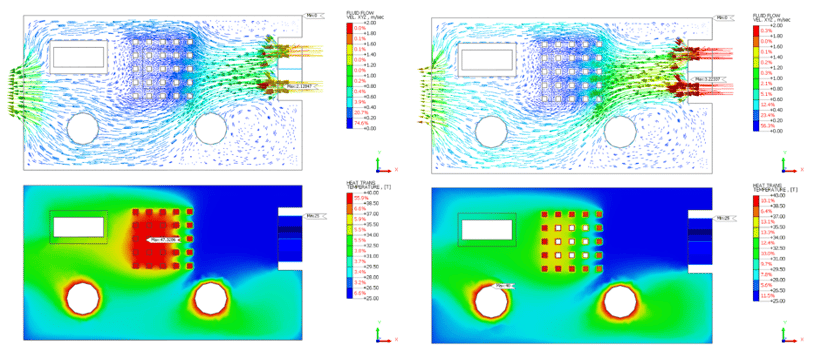
Flow resistance characteristics can typically be represented by pressure-loss versus velocity relationships. When experimental data are unavailable, a representative unit model can be analyzed to estimate the pressure-drop characteristics and then applied to the full-scale system.
.....
Explore the Full Resource
Get practical insights, proven approaches, and real-world engineering examples