

Overview
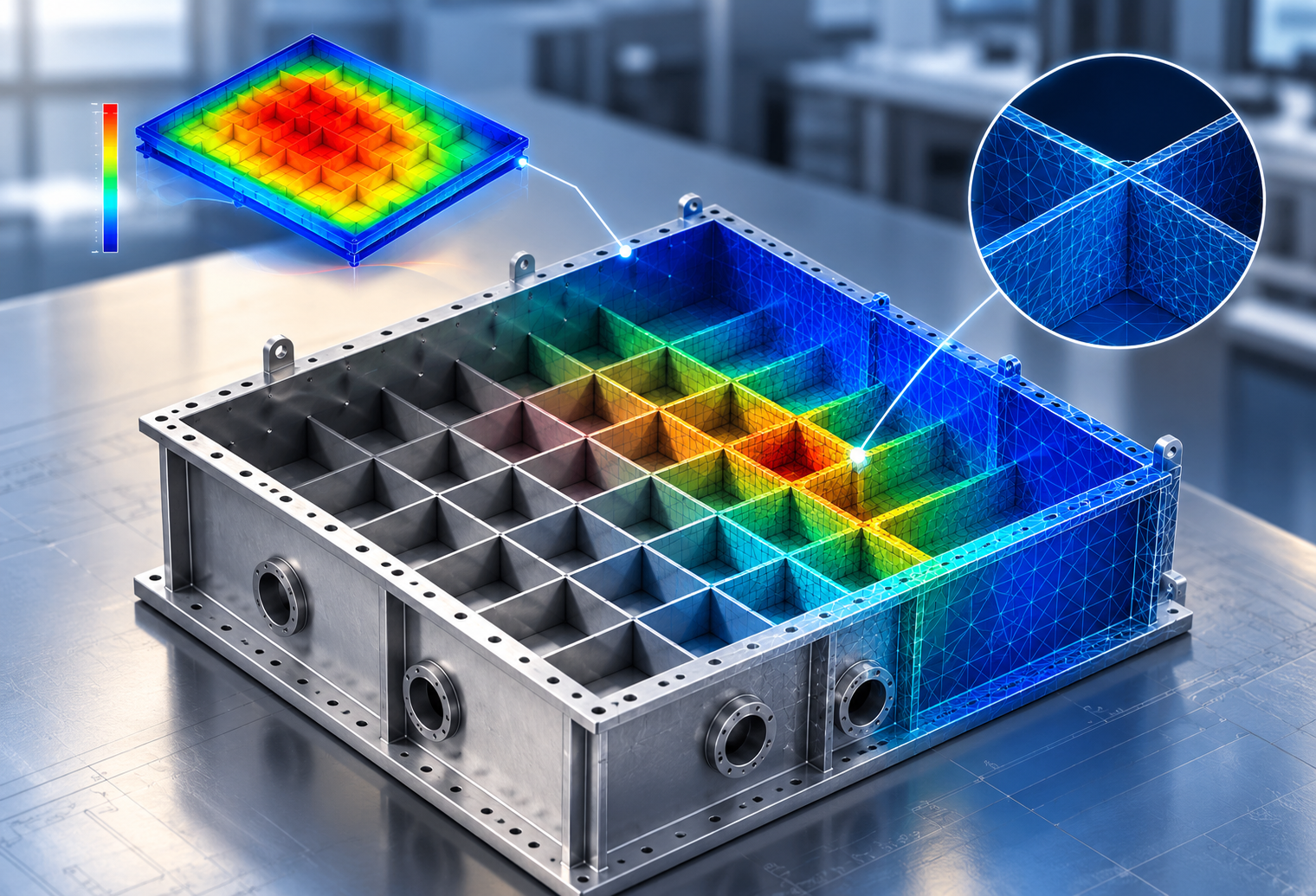
1. Thermal Load Analysis Based on Temperature Distribution
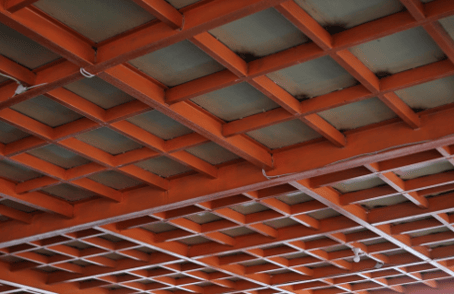
A stiffener is a reinforcing member used across various industrial fields — including mechanical equipment and architectural structures — to increase the stiffness of a structure. Stiffeners serve to prevent deformation of thin plate or shell structures and to improve their resistance to external loads.
There are several methods for evaluating structural stability. One approach involves obtaining the temperature distribution through thermal transfer analysis, setting thermal stress due to thermal expansion and internal/external pressure as boundary conditions, and then examining additional mechanical deformation and stress.
2. The Importance of Stiffeners in Structural and Mechanical Equipment Chambers
Stiffeners, the subject of this discussion, are applied in various forms and are generally classified as follows.
1. Stiffeners are categorized into Longitudinal Stiffeners and Transverse Stiffeners. Longitudinal stiffeners are arranged along the length of the structure to increase axial stiffness, while transverse stiffeners are arranged along the width of the structure to enhance lateral stiffness.
2. By shape, stiffeners are classified into Plate Stiffeners and Angle Stiffeners. Plate stiffeners are fabricated in a flat plate form and are primarily attached to plate structures, while angle stiffeners are fabricated in an L-shape to reinforce the stiffness at corner sections. Stiffeners are utilized across a wide range of fields, including shipbuilding, aerospace, and architectural structures, and are essential elements that improve the stability and durability of structures.
3. Stiffeners and chambers are independent concepts; however, stiffeners may be applied to increase the stiffness of a chamber structure as needed. For example, attaching stiffeners to the walls of a large chamber can prevent structural deformation and enhance resistance to changes in internal pressure.

3. Why Is Selecting 2D Elements More Efficient?
The reasons for selecting 2D elements for efficient analysis are as follows.
First, this applies when the geometry of the analysis target can be treated as 2D. For structures such as thin plates, shells, and membranes — where the thickness in one direction is very small and deformation occurs primarily in-plane — 2D elements are appropriate. In addition, structures with a uniform cross-sectional shape, such as beams, girders, plates, and cylinders, can achieve sufficient accuracy through 2D analysis.
Second, computational costs can be reduced, and analysis speed can be increased. Compared to 3D analysis, the number of elements and degrees of freedom are reduced, resulting in a significant decrease in computation time. In particular, the larger and more complex the analysis model, the greater the improvement in analysis speed that can be achieved by using 2D analysis.
Third, efficient analysis is possible while maintaining accuracy. When 3D analysis is not required, using 2D analysis enables a more efficient study while maintaining equivalent accuracy. In particular, for analyses focused on specific cross-sections — such as stress analysis or thermal analysis — sufficient results can be obtained with a 2D model alone.
.....
Explore the Full Resource
Get practical insights, proven approaches, and real-world engineering examples