


Overview
1. Thermal Management Through Thermal-Fluid Analysis
Facilities such as ESS and data centers contain densely packed batteries, servers, and electrical equipment with high heat generation rates within confined spaces. As temperatures rise, performance degradation may occur, and there is a risk of large-scale fires or explosions. Therefore, effective thermal management is essential.
Because heat is generated over a wide area, conventional cooling methods such as water cooling or cold plates may have limitations. As a result, cooling effects using HVAC systems are commonly considered. The most important factor is ensuring that cool air is efficiently delivered to heat-generating regions, which requires proper engineering validation through simulation.

Materials in the Electrical Equipment
2. Why Are Air-Based HVAC Systems Widely Used?
Although various thermal management approaches exist, most cooling systems—except for specialized cases such as Peltier devices—are designed based on fluid cooling using either liquids or gases. In general, heat is generated from solid components and transferred to a fluid, which then removes the heat to the surrounding environment. This concept can easily be understood through everyday examples such as cooling the body with a fan or air conditioner.
However, liquids and gases exhibit significantly different characteristics. Liquids generally provide superior cooling performance due to their higher thermal conductivity. However, with densities typically exceeding 1000 kg/m³, gravity has a substantial influence on flow behavior. As a result, liquid cooling systems often require piping networks to effectively cool localized heat sources, which can introduce design constraints and space limitations. For this reason, liquid cooling is typically applied to high-power components or precision equipment.
Thermal analysis
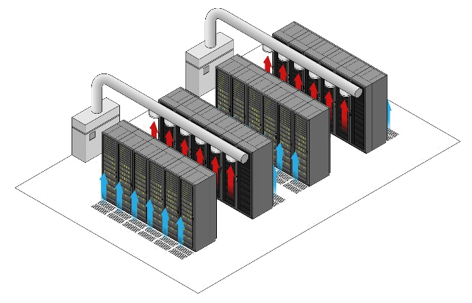
In contrast, gases have relatively low density and are influenced more by surrounding airflow than by gravity. This characteristic allows airflow paths to be designed with greater flexibility and fewer spatial constraints. Using cooling fans or HVAC systems, airflow can be supplied uniformly throughout the entire space. Air can be directed intensively toward specific regions, distributed broadly across large spaces, or delivered evenly throughout an enclosed area. These advantages make air cooling one of the most widely adopted thermal management solutions.
.....
Explore the Full Resource
Get practical insights, proven approaches, and real-world engineering examples