


Overview
1. Review of airflow analysis outside Kuwait Stadium
The topic we will cover today is “external airflow analysis” of structures.

Exterior Geometry of a Kuwait Stadium
A stadium is a large-scale structure that is often significantly larger than surrounding buildings. In addition to hosting sports events such as soccer and baseball, stadiums may also be used for large public events, including opening and closing ceremonies for international competitions such as the Olympics.

Interior Geometry of a Kuwait Stadium
Due to their large walls and complex structural configuration, stadiums can significantly disturb the surrounding airflow. As wind passes around the structure, flow separation and large recirculation regions may occur, resulting in localized changes in velocity and pressure.
2. Why is it necessary to review external airflow analysis for structures?
These airflow characteristics can affect both the stadium structure itself and temporary or permanent installations located inside and around the stadium. Depending on the installation layout and wind conditions, potential risks such as increased wind pressure, vibration, resonance, and structural damage may arise. Therefore, it is important to evaluate external airflow behavior during the design and review process.
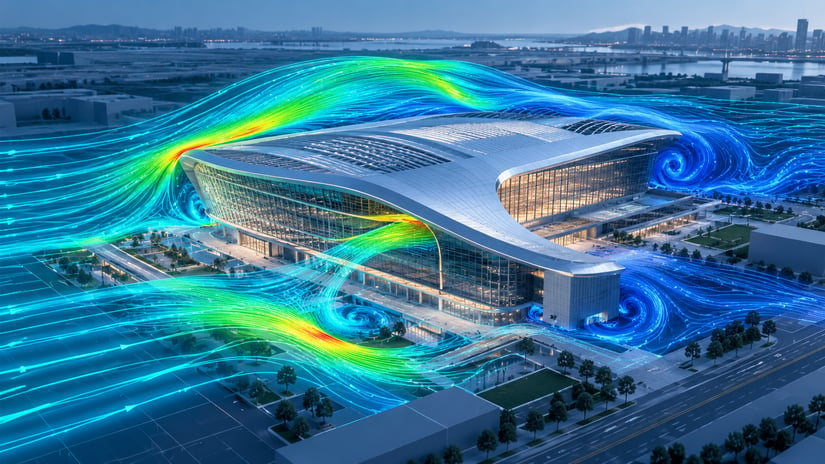
Example of External Airflow Analysis
CFD analysis provides a practical method for visualizing and assessing airflow around stadium structures. By predicting flow paths, recirculation zones, pressure distributions, and regions of high wind load, engineers can identify potential risk areas and support safer structural and installation design.
3. How can we define and design “external airflow”?
External airflow refers to the flow of air around the outside of a structure. In CFD analysis, the surrounding airflow and structural geometry can be modeled at full scale in a virtual environment to evaluate velocity variations around the structure and pressure distributions on its surfaces.
The aerodynamic loads obtained from CFD analysis can also be used for structural evaluation. By transferring flow-induced pressure data to a structural analysis model, engineers can assess wind-induced deformation, maximum displacement, and potential resonance effects on installed structures or external components.
.....
Explore the Full Resource
Get practical insights, proven approaches, and real-world engineering examples